Missile drill in Tehran, panic in Tel Aviv
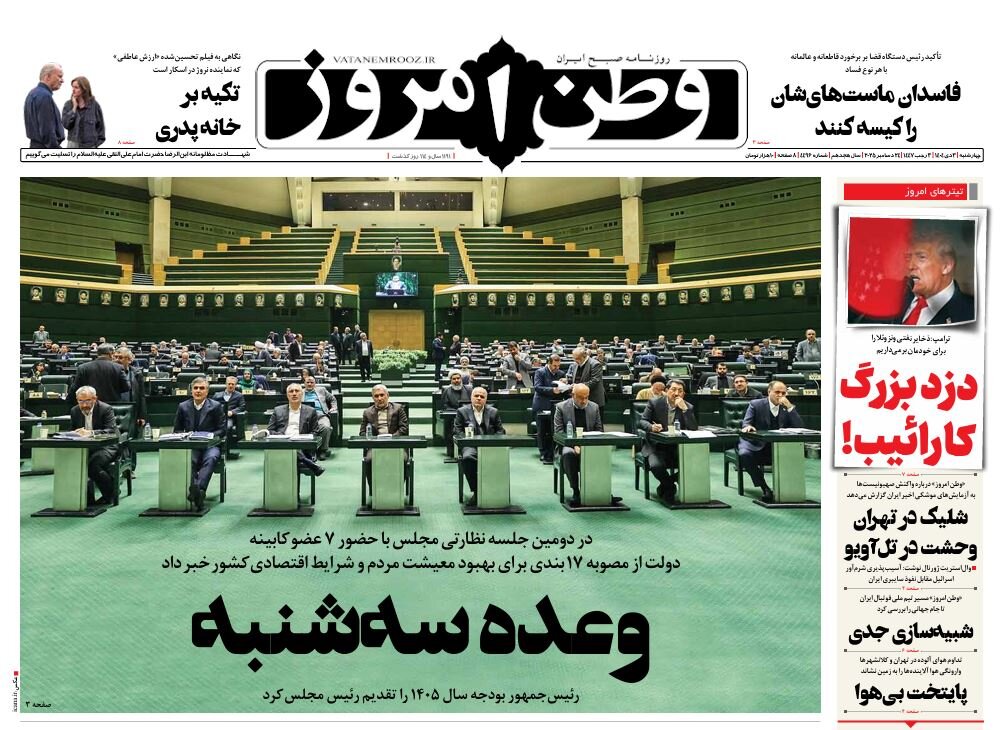
TEHRAN - Vatan-e-Emrooz analyzed Iran’s large-scale missile maneuver on Monday.
The newspaper wrote: The simultaneous launch of ballistic missiles in the maneuver has had a profound impact on the security calculations of the Zionist regime. It was a show of force that served as a decisive and deterrent response to recent Israeli rhetoric, demonstrating that threats against Iran’s missile program will not go unanswered. The maneuver not only proved the rapid reconstruction of Iran’s missile arsenal after the June 12-day war, but also sent a clear message to Tel Aviv: any plan for renewed attacks or aggressive rhetoric will be met with a firm response. As a result, Israel’s approach has shifted significantly—from aggression toward caution—in its media and political discourse regarding Tehran’s missile program. Iran carried out the maneuver without an official announcement, and the Islamic Revolution Guard Corps neither confirmed nor denied it, as no explanation was deemed necessary. The primary audience of the message was decision-makers in Tel Aviv and Washington. This strategic silence, combined with a practical display of power, underscored Tehran’s focus on action rather than verbal propaganda.
Sobh-e-No: Protecting commercial vessels and ensuring their safe passage
Sobh-e-No devoted an article to the dispatch of an Iranian Navy flotilla to distant waters. In the paper’s view, this presence carries meaning and significance beyond an ordinary naval mission. It is presented as a practical response to the disorder that the United States has created at sea. Escorting commercial ships is not a symbolic display, but rather an effort to redefine maritime security based on responsibility and respect for international law. The message of this naval presence is twofold. On the one hand, it demonstrates Iran’s ability to operate effectively in distant waters and to defend trade routes. On the other hand, it conveys that maritime security should not be monopolized by powers that are themselves its greatest violators. In a world where the United States has turned “security” into a tool of political pressure, such actions carry important messages. Importantly, unlike Washington, Iran does not frame its actions in terms of blockade or sanctions. The declared objective is the protection of commercial vessels and the assurance of their safe passage—an approach that stands in direct contrast to U.S. behavior. This distinction carries considerable legal and political weight, highlighting two fundamentally different interpretations of maritime order.
Javan: Venezuela is a test for the world to resist bullying
Javan wrote about the escalating tensions between the United States and Venezuela: Today, Venezuela is regarded as a vital stronghold of the resistance front against American hegemony, and comprehensive support—especially political support—for this country is deemed essential. A unilateral U.S. success in overthrowing Venezuela’s government, beyond its strategic and economic consequences, could revive the practice of toppling independent governments unilaterally, which would pose a serious threat to international order. Therefore, the formation of united fronts against such policies is necessary, and the Islamic Republic of Iran can play a pivotal role in this path. Leaders of independent countries, particularly Iran, should view Venezuela as the front line in defending multilateralism in the independent world. Geographic distance must not reduce attention to this issue, because developments in Venezuela directly affect the future global order. The decisive days Venezuela is now experiencing are decisive for the entire world, and any neglect in supporting the Venezuelan people may carry costs for all peoples worldwide.
Khorasan: A shift in balance of deterrence
Khorasan examined remarks by U.S. Senator Lindsey Graham about Iran’s missile threat. Graham, speaking to the Jerusalem Post in a warning tone, declared that Iran’s ballistic missiles now represent a threat equal to its nuclear program for Israel. According to him, Iran—through the development and rebuilding of its ballistic missile arsenal after the 12-day war—has reached a capacity capable of disabling the Iron Dome. This admission essentially echoes the growing concerns voiced in Israeli and American security circles in recent months. More than a mere description of reality, this framing is seen as an attempt to legitimize greater pressure—whether through sanctions, military action, or increased arms support—against Iran and its allies. Nevertheless, battlefield evidence from the 12-day war shows that Graham’s concerns have a concrete basis. In this context, his remarks can be read not merely as a warning but as an indirect acknowledgment of a shift in the balance of deterrence.
Leave a Comment